 ROS Index
Repository Summary
| Checkout URI | https://github.com/facontidavide/cloudini.git |
| VCS Type | git |
| VCS Version | main |
| Last Updated | 2026-09-28 |
| Dev Status | DEVELOPED |
| Released | RELEASED |
| Contributing |
Help Wanted (-)
Good First Issues (-) Pull Requests to Review (-) |
Packages
| Name | Version |
|---|---|
| cloudini_lib | 1.4.1 |
| cloudini_ros | 1.4.1 |
README
| Packages |
  
|
| Build |
   
|
| ROS 2 |
   
|

Cloudini (pronounced with Italian accent) is a pointcloud compression library.
Its main focus is speed, but it still achieves very good compression ratios.
Its main use cases are:
-
To improve the storage of datasets containing pointcloud data (being a notable example rosbags).
-
Decrease the bandwidth used when streaming pointclouds over a network.
It works seamlessly with PCL and ROS, but the main library can be compiled and used independently, if needed.
What to expect
The compression ratio is hard to predict because it depends on the way the original data is encoded.
For example, ROS pointcloud messages are extremely inefficient, because they include some “padding” in the message that, in extreme cases, may reach up to 50%.
(Yes, you heard correctly, almost 50% of that 10 Gb rosbag is useless padding).
But, in general, you may expect considerably better compression, at a similar or higher speed, than ZSTD or LZ4 alone.
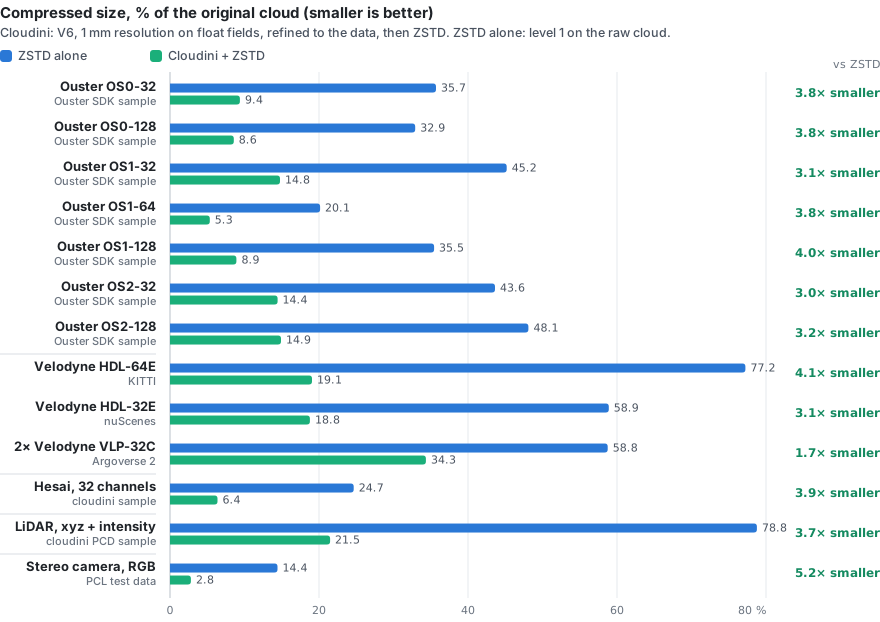
These are measurements on real-world clouds from 13 sensors (public datasets and the samples in this repository), with the 1.4.0 defaults: V6 at 1 mm resolution, refined to the data, followed by ZSTD. “ZSTD alone” is ZSTD level 1, the level Cloudini uses, on the same raw cloud.
Cloudini adds little or no time on top of ZSTD, because ZSTD has much less data left to compress: encoding is 1.4–2× faster than ZSTD alone on the Velodyne clouds, the PCD sample and the stereo cloud, and 0.87–1.05× its speed on Ouster and Hesai. Decoding runs at 0.67× (Hesai) to 1.42× (KITTI) the speed of ZSTD alone.
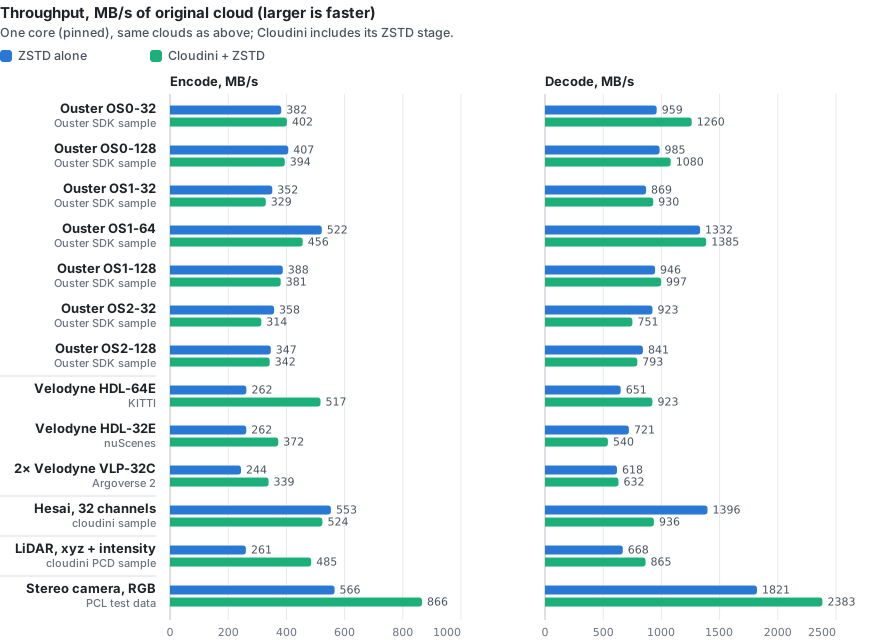
Measured on one pinned core of an i7-13700H laptop, best of 5 runs.
You can measure the compression ratio and speed on your own data with mcap_codec_benchmark, built with cloudini_lib
(no ROS needed), on any MCAP file containing sensor_msgs/msg/PointCloud2 topics:
./build/release/tools/mcap_codec_benchmark my_bag.mcap --mode V6 --zstd
How it works
The algorithm contains two steps:
The encoding is lossy for floating point channels (typically the X, Y, Z channels)
and lossless for RGBA and integer channels (packed colors stored in a FLOAT32 field
named rgb/rgba are detected by name and never quantized).
Now, I know that when you read the word “lossy” you may think about grainy JPEGS images. Don’t.
The encoder applies a quantization using a resolution provided by the user.
Typical LiDARs have an accuracy/noise in the order of +/- 1 cm. Therefore, using a resolution of 1 mm (+/- 0.5 mm max quantization error) is usually a very conservative option.
Compile instructions
Some dependencies are downloaded automatically using CPM. To avoid downloading them again when you rebuild your project, I suggest setting CPM_SOURCE_CACHE as described here.
To build the main library (cloudini_lib)
cmake -B build/release -S cloudini_lib -DCMAKE_BUILD_TYPE=Release
cmake --build build/release --parallel
ROS compilation
To compile it with ROS, just pull this repo into your ws/src folder and execute colcon build as usual.
ROS specific utilities
For more information, see the cloudini_ros/README.md
-
point_cloud_transport plugins: see point_cloud_transport plugins for reference about how they are used.
-
cloudini_topic_converter: a node that converts a
sensor_msgs/PointCloud2topic into a compressedpoint_cloud_interfaces/CompressedPointCloud2(compressing:=true), or vice-versa (compressing:=false). -
cloudini_rosbag_converter: a command line tool that, given a rosbag (limited to MCAP format), converts all
sensor_msgs/PointCloud2topics into compressedpoint_cloud_interfaces/CompressedPointCloud2or vice-versa. It does not need a ROS installation: a pre-compiled Linux AppImage can be downloaded from the release page.
Compiling the WASM module
File truncated at 100 lines see the full file
CONTRIBUTING
Repository Summary
| Checkout URI | https://github.com/facontidavide/cloudini.git |
| VCS Type | git |
| VCS Version | main |
| Last Updated | 2026-09-28 |
| Dev Status | DEVELOPED |
| Released | RELEASED |
| Contributing |
Help Wanted (-)
Good First Issues (-) Pull Requests to Review (-) |
Packages
| Name | Version |
|---|---|
| cloudini_lib | 1.4.1 |
| cloudini_ros | 1.4.1 |
README
| Packages |
|
| Build |
|
| ROS 2 |
|
Cloudini (pronounced with Italian accent) is a pointcloud compression library.
Its main focus is speed, but it still achieves very good compression ratios.
Its main use cases are:
-
To improve the storage of datasets containing pointcloud data (being a notable example rosbags).
-
Decrease the bandwidth used when streaming pointclouds over a network.
It works seamlessly with PCL and ROS, but the main library can be compiled and used independently, if needed.
What to expect
The compression ratio is hard to predict because it depends on the way the original data is encoded.
For example, ROS pointcloud messages are extremely inefficient, because they include some “padding” in the message that, in extreme cases, may reach up to 50%.
(Yes, you heard correctly, almost 50% of that 10 Gb rosbag is useless padding).
But, in general, you may expect considerably better compression, at a similar or higher speed, than ZSTD or LZ4 alone.
These are measurements on real-world clouds from 13 sensors (public datasets and the samples in this repository), with the 1.4.0 defaults: V6 at 1 mm resolution, refined to the data, followed by ZSTD. “ZSTD alone” is ZSTD level 1, the level Cloudini uses, on the same raw cloud.
Cloudini adds little or no time on top of ZSTD, because ZSTD has much less data left to compress: encoding is 1.4–2× faster than ZSTD alone on the Velodyne clouds, the PCD sample and the stereo cloud, and 0.87–1.05× its speed on Ouster and Hesai. Decoding runs at 0.67× (Hesai) to 1.42× (KITTI) the speed of ZSTD alone.
Measured on one pinned core of an i7-13700H laptop, best of 5 runs.
You can measure the compression ratio and speed on your own data with mcap_codec_benchmark, built with cloudini_lib
(no ROS needed), on any MCAP file containing sensor_msgs/msg/PointCloud2 topics:
./build/release/tools/mcap_codec_benchmark my_bag.mcap --mode V6 --zstd
How it works
The algorithm contains two steps:
The encoding is lossy for floating point channels (typically the X, Y, Z channels)
and lossless for RGBA and integer channels (packed colors stored in a FLOAT32 field
named rgb/rgba are detected by name and never quantized).
Now, I know that when you read the word “lossy” you may think about grainy JPEGS images. Don’t.
The encoder applies a quantization using a resolution provided by the user.
Typical LiDARs have an accuracy/noise in the order of +/- 1 cm. Therefore, using a resolution of 1 mm (+/- 0.5 mm max quantization error) is usually a very conservative option.
Compile instructions
Some dependencies are downloaded automatically using CPM. To avoid downloading them again when you rebuild your project, I suggest setting CPM_SOURCE_CACHE as described here.
To build the main library (cloudini_lib)
cmake -B build/release -S cloudini_lib -DCMAKE_BUILD_TYPE=Release
cmake --build build/release --parallel
ROS compilation
To compile it with ROS, just pull this repo into your ws/src folder and execute colcon build as usual.
ROS specific utilities
For more information, see the cloudini_ros/README.md
-
point_cloud_transport plugins: see point_cloud_transport plugins for reference about how they are used.
-
cloudini_topic_converter: a node that converts a
sensor_msgs/PointCloud2topic into a compressedpoint_cloud_interfaces/CompressedPointCloud2(compressing:=true), or vice-versa (compressing:=false). -
cloudini_rosbag_converter: a command line tool that, given a rosbag (limited to MCAP format), converts all
sensor_msgs/PointCloud2topics into compressedpoint_cloud_interfaces/CompressedPointCloud2or vice-versa. It does not need a ROS installation: a pre-compiled Linux AppImage can be downloaded from the release page.
Compiling the WASM module
File truncated at 100 lines see the full file
CONTRIBUTING
Repository Summary
| Checkout URI | https://github.com/facontidavide/cloudini.git |
| VCS Type | git |
| VCS Version | main |
| Last Updated | 2026-09-28 |
| Dev Status | DEVELOPED |
| Released | RELEASED |
| Contributing |
Help Wanted (-)
Good First Issues (-) Pull Requests to Review (-) |
Packages
| Name | Version |
|---|---|
| cloudini_lib | 1.4.1 |
| cloudini_ros | 1.4.1 |
README
| Packages |
|
| Build |
|
| ROS 2 |
|
Cloudini (pronounced with Italian accent) is a pointcloud compression library.
Its main focus is speed, but it still achieves very good compression ratios.
Its main use cases are:
-
To improve the storage of datasets containing pointcloud data (being a notable example rosbags).
-
Decrease the bandwidth used when streaming pointclouds over a network.
It works seamlessly with PCL and ROS, but the main library can be compiled and used independently, if needed.
What to expect
The compression ratio is hard to predict because it depends on the way the original data is encoded.
For example, ROS pointcloud messages are extremely inefficient, because they include some “padding” in the message that, in extreme cases, may reach up to 50%.
(Yes, you heard correctly, almost 50% of that 10 Gb rosbag is useless padding).
But, in general, you may expect considerably better compression, at a similar or higher speed, than ZSTD or LZ4 alone.
These are measurements on real-world clouds from 13 sensors (public datasets and the samples in this repository), with the 1.4.0 defaults: V6 at 1 mm resolution, refined to the data, followed by ZSTD. “ZSTD alone” is ZSTD level 1, the level Cloudini uses, on the same raw cloud.
Cloudini adds little or no time on top of ZSTD, because ZSTD has much less data left to compress: encoding is 1.4–2× faster than ZSTD alone on the Velodyne clouds, the PCD sample and the stereo cloud, and 0.87–1.05× its speed on Ouster and Hesai. Decoding runs at 0.67× (Hesai) to 1.42× (KITTI) the speed of ZSTD alone.
Measured on one pinned core of an i7-13700H laptop, best of 5 runs.
You can measure the compression ratio and speed on your own data with mcap_codec_benchmark, built with cloudini_lib
(no ROS needed), on any MCAP file containing sensor_msgs/msg/PointCloud2 topics:
./build/release/tools/mcap_codec_benchmark my_bag.mcap --mode V6 --zstd
How it works
The algorithm contains two steps:
The encoding is lossy for floating point channels (typically the X, Y, Z channels)
and lossless for RGBA and integer channels (packed colors stored in a FLOAT32 field
named rgb/rgba are detected by name and never quantized).
Now, I know that when you read the word “lossy” you may think about grainy JPEGS images. Don’t.
The encoder applies a quantization using a resolution provided by the user.
Typical LiDARs have an accuracy/noise in the order of +/- 1 cm. Therefore, using a resolution of 1 mm (+/- 0.5 mm max quantization error) is usually a very conservative option.
Compile instructions
Some dependencies are downloaded automatically using CPM. To avoid downloading them again when you rebuild your project, I suggest setting CPM_SOURCE_CACHE as described here.
To build the main library (cloudini_lib)
cmake -B build/release -S cloudini_lib -DCMAKE_BUILD_TYPE=Release
cmake --build build/release --parallel
ROS compilation
To compile it with ROS, just pull this repo into your ws/src folder and execute colcon build as usual.
ROS specific utilities
For more information, see the cloudini_ros/README.md
-
point_cloud_transport plugins: see point_cloud_transport plugins for reference about how they are used.
-
cloudini_topic_converter: a node that converts a
sensor_msgs/PointCloud2topic into a compressedpoint_cloud_interfaces/CompressedPointCloud2(compressing:=true), or vice-versa (compressing:=false). -
cloudini_rosbag_converter: a command line tool that, given a rosbag (limited to MCAP format), converts all
sensor_msgs/PointCloud2topics into compressedpoint_cloud_interfaces/CompressedPointCloud2or vice-versa. It does not need a ROS installation: a pre-compiled Linux AppImage can be downloaded from the release page.
Compiling the WASM module
File truncated at 100 lines see the full file
CONTRIBUTING
Repository Summary
| Checkout URI | https://github.com/facontidavide/cloudini.git |
| VCS Type | git |
| VCS Version | main |
| Last Updated | 2026-09-28 |
| Dev Status | DEVELOPED |
| Released | RELEASED |
| Contributing |
Help Wanted (-)
Good First Issues (-) Pull Requests to Review (-) |
Packages
| Name | Version |
|---|---|
| cloudini_lib | 1.4.1 |
| cloudini_ros | 1.4.1 |
README
| Packages |
|
| Build |
|
| ROS 2 |
|
Cloudini (pronounced with Italian accent) is a pointcloud compression library.
Its main focus is speed, but it still achieves very good compression ratios.
Its main use cases are:
-
To improve the storage of datasets containing pointcloud data (being a notable example rosbags).
-
Decrease the bandwidth used when streaming pointclouds over a network.
It works seamlessly with PCL and ROS, but the main library can be compiled and used independently, if needed.
What to expect
The compression ratio is hard to predict because it depends on the way the original data is encoded.
For example, ROS pointcloud messages are extremely inefficient, because they include some “padding” in the message that, in extreme cases, may reach up to 50%.
(Yes, you heard correctly, almost 50% of that 10 Gb rosbag is useless padding).
But, in general, you may expect considerably better compression, at a similar or higher speed, than ZSTD or LZ4 alone.
These are measurements on real-world clouds from 13 sensors (public datasets and the samples in this repository), with the 1.4.0 defaults: V6 at 1 mm resolution, refined to the data, followed by ZSTD. “ZSTD alone” is ZSTD level 1, the level Cloudini uses, on the same raw cloud.
Cloudini adds little or no time on top of ZSTD, because ZSTD has much less data left to compress: encoding is 1.4–2× faster than ZSTD alone on the Velodyne clouds, the PCD sample and the stereo cloud, and 0.87–1.05× its speed on Ouster and Hesai. Decoding runs at 0.67× (Hesai) to 1.42× (KITTI) the speed of ZSTD alone.
Measured on one pinned core of an i7-13700H laptop, best of 5 runs.
You can measure the compression ratio and speed on your own data with mcap_codec_benchmark, built with cloudini_lib
(no ROS needed), on any MCAP file containing sensor_msgs/msg/PointCloud2 topics:
./build/release/tools/mcap_codec_benchmark my_bag.mcap --mode V6 --zstd
How it works
The algorithm contains two steps:
The encoding is lossy for floating point channels (typically the X, Y, Z channels)
and lossless for RGBA and integer channels (packed colors stored in a FLOAT32 field
named rgb/rgba are detected by name and never quantized).
Now, I know that when you read the word “lossy” you may think about grainy JPEGS images. Don’t.
The encoder applies a quantization using a resolution provided by the user.
Typical LiDARs have an accuracy/noise in the order of +/- 1 cm. Therefore, using a resolution of 1 mm (+/- 0.5 mm max quantization error) is usually a very conservative option.
Compile instructions
Some dependencies are downloaded automatically using CPM. To avoid downloading them again when you rebuild your project, I suggest setting CPM_SOURCE_CACHE as described here.
To build the main library (cloudini_lib)
cmake -B build/release -S cloudini_lib -DCMAKE_BUILD_TYPE=Release
cmake --build build/release --parallel
ROS compilation
To compile it with ROS, just pull this repo into your ws/src folder and execute colcon build as usual.
ROS specific utilities
For more information, see the cloudini_ros/README.md
-
point_cloud_transport plugins: see point_cloud_transport plugins for reference about how they are used.
-
cloudini_topic_converter: a node that converts a
sensor_msgs/PointCloud2topic into a compressedpoint_cloud_interfaces/CompressedPointCloud2(compressing:=true), or vice-versa (compressing:=false). -
cloudini_rosbag_converter: a command line tool that, given a rosbag (limited to MCAP format), converts all
sensor_msgs/PointCloud2topics into compressedpoint_cloud_interfaces/CompressedPointCloud2or vice-versa. It does not need a ROS installation: a pre-compiled Linux AppImage can be downloaded from the release page.
Compiling the WASM module
File truncated at 100 lines see the full file
CONTRIBUTING
Repository Summary
| Checkout URI | https://github.com/facontidavide/cloudini.git |
| VCS Type | git |
| VCS Version | main |
| Last Updated | 2026-09-28 |
| Dev Status | DEVELOPED |
| Released | UNRELEASED |
| Contributing |
Help Wanted (-)
Good First Issues (-) Pull Requests to Review (-) |
Packages
| Name | Version |
|---|---|
| cloudini_lib | 1.4.1 |
| cloudini_ros | 1.4.1 |
README
| Packages |
|
| Build |
|
| ROS 2 |
|
Cloudini (pronounced with Italian accent) is a pointcloud compression library.
Its main focus is speed, but it still achieves very good compression ratios.
Its main use cases are:
-
To improve the storage of datasets containing pointcloud data (being a notable example rosbags).
-
Decrease the bandwidth used when streaming pointclouds over a network.
It works seamlessly with PCL and ROS, but the main library can be compiled and used independently, if needed.
What to expect
The compression ratio is hard to predict because it depends on the way the original data is encoded.
For example, ROS pointcloud messages are extremely inefficient, because they include some “padding” in the message that, in extreme cases, may reach up to 50%.
(Yes, you heard correctly, almost 50% of that 10 Gb rosbag is useless padding).
But, in general, you may expect considerably better compression, at a similar or higher speed, than ZSTD or LZ4 alone.
These are measurements on real-world clouds from 13 sensors (public datasets and the samples in this repository), with the 1.4.0 defaults: V6 at 1 mm resolution, refined to the data, followed by ZSTD. “ZSTD alone” is ZSTD level 1, the level Cloudini uses, on the same raw cloud.
Cloudini adds little or no time on top of ZSTD, because ZSTD has much less data left to compress: encoding is 1.4–2× faster than ZSTD alone on the Velodyne clouds, the PCD sample and the stereo cloud, and 0.87–1.05× its speed on Ouster and Hesai. Decoding runs at 0.67× (Hesai) to 1.42× (KITTI) the speed of ZSTD alone.
Measured on one pinned core of an i7-13700H laptop, best of 5 runs.
You can measure the compression ratio and speed on your own data with mcap_codec_benchmark, built with cloudini_lib
(no ROS needed), on any MCAP file containing sensor_msgs/msg/PointCloud2 topics:
./build/release/tools/mcap_codec_benchmark my_bag.mcap --mode V6 --zstd
How it works
The algorithm contains two steps:
The encoding is lossy for floating point channels (typically the X, Y, Z channels)
and lossless for RGBA and integer channels (packed colors stored in a FLOAT32 field
named rgb/rgba are detected by name and never quantized).
Now, I know that when you read the word “lossy” you may think about grainy JPEGS images. Don’t.
The encoder applies a quantization using a resolution provided by the user.
Typical LiDARs have an accuracy/noise in the order of +/- 1 cm. Therefore, using a resolution of 1 mm (+/- 0.5 mm max quantization error) is usually a very conservative option.
Compile instructions
Some dependencies are downloaded automatically using CPM. To avoid downloading them again when you rebuild your project, I suggest setting CPM_SOURCE_CACHE as described here.
To build the main library (cloudini_lib)
cmake -B build/release -S cloudini_lib -DCMAKE_BUILD_TYPE=Release
cmake --build build/release --parallel
ROS compilation
To compile it with ROS, just pull this repo into your ws/src folder and execute colcon build as usual.
ROS specific utilities
For more information, see the cloudini_ros/README.md
-
point_cloud_transport plugins: see point_cloud_transport plugins for reference about how they are used.
-
cloudini_topic_converter: a node that converts a
sensor_msgs/PointCloud2topic into a compressedpoint_cloud_interfaces/CompressedPointCloud2(compressing:=true), or vice-versa (compressing:=false). -
cloudini_rosbag_converter: a command line tool that, given a rosbag (limited to MCAP format), converts all
sensor_msgs/PointCloud2topics into compressedpoint_cloud_interfaces/CompressedPointCloud2or vice-versa. It does not need a ROS installation: a pre-compiled Linux AppImage can be downloaded from the release page.
Compiling the WASM module
File truncated at 100 lines see the full file
CONTRIBUTING
Repository Summary
| Checkout URI | https://github.com/facontidavide/cloudini.git |
| VCS Type | git |
| VCS Version | main |
| Last Updated | 2026-09-28 |
| Dev Status | DEVELOPED |
| Released | RELEASED |
| Contributing |
Help Wanted (-)
Good First Issues (-) Pull Requests to Review (-) |
Packages
| Name | Version |
|---|---|
| cloudini_lib | 1.4.1 |
| cloudini_ros | 1.4.1 |
README
| Packages |
|
| Build |
|
| ROS 2 |
|
Cloudini (pronounced with Italian accent) is a pointcloud compression library.
Its main focus is speed, but it still achieves very good compression ratios.
Its main use cases are:
-
To improve the storage of datasets containing pointcloud data (being a notable example rosbags).
-
Decrease the bandwidth used when streaming pointclouds over a network.
It works seamlessly with PCL and ROS, but the main library can be compiled and used independently, if needed.
What to expect
The compression ratio is hard to predict because it depends on the way the original data is encoded.
For example, ROS pointcloud messages are extremely inefficient, because they include some “padding” in the message that, in extreme cases, may reach up to 50%.
(Yes, you heard correctly, almost 50% of that 10 Gb rosbag is useless padding).
But, in general, you may expect considerably better compression, at a similar or higher speed, than ZSTD or LZ4 alone.
These are measurements on real-world clouds from 13 sensors (public datasets and the samples in this repository), with the 1.4.0 defaults: V6 at 1 mm resolution, refined to the data, followed by ZSTD. “ZSTD alone” is ZSTD level 1, the level Cloudini uses, on the same raw cloud.
Cloudini adds little or no time on top of ZSTD, because ZSTD has much less data left to compress: encoding is 1.4–2× faster than ZSTD alone on the Velodyne clouds, the PCD sample and the stereo cloud, and 0.87–1.05× its speed on Ouster and Hesai. Decoding runs at 0.67× (Hesai) to 1.42× (KITTI) the speed of ZSTD alone.
Measured on one pinned core of an i7-13700H laptop, best of 5 runs.
You can measure the compression ratio and speed on your own data with mcap_codec_benchmark, built with cloudini_lib
(no ROS needed), on any MCAP file containing sensor_msgs/msg/PointCloud2 topics:
./build/release/tools/mcap_codec_benchmark my_bag.mcap --mode V6 --zstd
How it works
The algorithm contains two steps:
The encoding is lossy for floating point channels (typically the X, Y, Z channels)
and lossless for RGBA and integer channels (packed colors stored in a FLOAT32 field
named rgb/rgba are detected by name and never quantized).
Now, I know that when you read the word “lossy” you may think about grainy JPEGS images. Don’t.
The encoder applies a quantization using a resolution provided by the user.
Typical LiDARs have an accuracy/noise in the order of +/- 1 cm. Therefore, using a resolution of 1 mm (+/- 0.5 mm max quantization error) is usually a very conservative option.
Compile instructions
Some dependencies are downloaded automatically using CPM. To avoid downloading them again when you rebuild your project, I suggest setting CPM_SOURCE_CACHE as described here.
To build the main library (cloudini_lib)
cmake -B build/release -S cloudini_lib -DCMAKE_BUILD_TYPE=Release
cmake --build build/release --parallel
ROS compilation
To compile it with ROS, just pull this repo into your ws/src folder and execute colcon build as usual.
ROS specific utilities
For more information, see the cloudini_ros/README.md
-
point_cloud_transport plugins: see point_cloud_transport plugins for reference about how they are used.
-
cloudini_topic_converter: a node that converts a
sensor_msgs/PointCloud2topic into a compressedpoint_cloud_interfaces/CompressedPointCloud2(compressing:=true), or vice-versa (compressing:=false). -
cloudini_rosbag_converter: a command line tool that, given a rosbag (limited to MCAP format), converts all
sensor_msgs/PointCloud2topics into compressedpoint_cloud_interfaces/CompressedPointCloud2or vice-versa. It does not need a ROS installation: a pre-compiled Linux AppImage can be downloaded from the release page.
Compiling the WASM module
File truncated at 100 lines see the full file
CONTRIBUTING
Repository Summary
| Checkout URI | https://github.com/facontidavide/cloudini.git |
| VCS Type | git |
| VCS Version | main |
| Last Updated | 2026-09-28 |
| Dev Status | DEVELOPED |
| Released | RELEASED |
| Contributing |
Help Wanted (-)
Good First Issues (-) Pull Requests to Review (-) |
Packages
| Name | Version |
|---|---|
| cloudini_lib | 1.4.1 |
| cloudini_ros | 1.4.1 |
README
| Packages |
|
| Build |
|
| ROS 2 |
|
Cloudini (pronounced with Italian accent) is a pointcloud compression library.
Its main focus is speed, but it still achieves very good compression ratios.
Its main use cases are:
-
To improve the storage of datasets containing pointcloud data (being a notable example rosbags).
-
Decrease the bandwidth used when streaming pointclouds over a network.
It works seamlessly with PCL and ROS, but the main library can be compiled and used independently, if needed.
What to expect
The compression ratio is hard to predict because it depends on the way the original data is encoded.
For example, ROS pointcloud messages are extremely inefficient, because they include some “padding” in the message that, in extreme cases, may reach up to 50%.
(Yes, you heard correctly, almost 50% of that 10 Gb rosbag is useless padding).
But, in general, you may expect considerably better compression, at a similar or higher speed, than ZSTD or LZ4 alone.
These are measurements on real-world clouds from 13 sensors (public datasets and the samples in this repository), with the 1.4.0 defaults: V6 at 1 mm resolution, refined to the data, followed by ZSTD. “ZSTD alone” is ZSTD level 1, the level Cloudini uses, on the same raw cloud.
Cloudini adds little or no time on top of ZSTD, because ZSTD has much less data left to compress: encoding is 1.4–2× faster than ZSTD alone on the Velodyne clouds, the PCD sample and the stereo cloud, and 0.87–1.05× its speed on Ouster and Hesai. Decoding runs at 0.67× (Hesai) to 1.42× (KITTI) the speed of ZSTD alone.
Measured on one pinned core of an i7-13700H laptop, best of 5 runs.
You can measure the compression ratio and speed on your own data with mcap_codec_benchmark, built with cloudini_lib
(no ROS needed), on any MCAP file containing sensor_msgs/msg/PointCloud2 topics:
./build/release/tools/mcap_codec_benchmark my_bag.mcap --mode V6 --zstd
How it works
The algorithm contains two steps:
The encoding is lossy for floating point channels (typically the X, Y, Z channels)
and lossless for RGBA and integer channels (packed colors stored in a FLOAT32 field
named rgb/rgba are detected by name and never quantized).
Now, I know that when you read the word “lossy” you may think about grainy JPEGS images. Don’t.
The encoder applies a quantization using a resolution provided by the user.
Typical LiDARs have an accuracy/noise in the order of +/- 1 cm. Therefore, using a resolution of 1 mm (+/- 0.5 mm max quantization error) is usually a very conservative option.
Compile instructions
Some dependencies are downloaded automatically using CPM. To avoid downloading them again when you rebuild your project, I suggest setting CPM_SOURCE_CACHE as described here.
To build the main library (cloudini_lib)
cmake -B build/release -S cloudini_lib -DCMAKE_BUILD_TYPE=Release
cmake --build build/release --parallel
ROS compilation
To compile it with ROS, just pull this repo into your ws/src folder and execute colcon build as usual.
ROS specific utilities
For more information, see the cloudini_ros/README.md
-
point_cloud_transport plugins: see point_cloud_transport plugins for reference about how they are used.
-
cloudini_topic_converter: a node that converts a
sensor_msgs/PointCloud2topic into a compressedpoint_cloud_interfaces/CompressedPointCloud2(compressing:=true), or vice-versa (compressing:=false). -
cloudini_rosbag_converter: a command line tool that, given a rosbag (limited to MCAP format), converts all
sensor_msgs/PointCloud2topics into compressedpoint_cloud_interfaces/CompressedPointCloud2or vice-versa. It does not need a ROS installation: a pre-compiled Linux AppImage can be downloaded from the release page.
Compiling the WASM module
File truncated at 100 lines see the full file
CONTRIBUTING
Repository Summary
| Checkout URI | https://github.com/facontidavide/cloudini.git |
| VCS Type | git |
| VCS Version | main |
| Last Updated | 2026-09-28 |
| Dev Status | DEVELOPED |
| Released | RELEASED |
| Contributing |
Help Wanted (-)
Good First Issues (-) Pull Requests to Review (-) |
Packages
| Name | Version |
|---|---|
| cloudini_lib | 1.4.1 |
| cloudini_ros | 1.4.1 |
README
| Packages |
|
| Build |
|
| ROS 2 |
|
Cloudini (pronounced with Italian accent) is a pointcloud compression library.
Its main focus is speed, but it still achieves very good compression ratios.
Its main use cases are:
-
To improve the storage of datasets containing pointcloud data (being a notable example rosbags).
-
Decrease the bandwidth used when streaming pointclouds over a network.
It works seamlessly with PCL and ROS, but the main library can be compiled and used independently, if needed.
What to expect
The compression ratio is hard to predict because it depends on the way the original data is encoded.
For example, ROS pointcloud messages are extremely inefficient, because they include some “padding” in the message that, in extreme cases, may reach up to 50%.
(Yes, you heard correctly, almost 50% of that 10 Gb rosbag is useless padding).
But, in general, you may expect considerably better compression, at a similar or higher speed, than ZSTD or LZ4 alone.
These are measurements on real-world clouds from 13 sensors (public datasets and the samples in this repository), with the 1.4.0 defaults: V6 at 1 mm resolution, refined to the data, followed by ZSTD. “ZSTD alone” is ZSTD level 1, the level Cloudini uses, on the same raw cloud.
Cloudini adds little or no time on top of ZSTD, because ZSTD has much less data left to compress: encoding is 1.4–2× faster than ZSTD alone on the Velodyne clouds, the PCD sample and the stereo cloud, and 0.87–1.05× its speed on Ouster and Hesai. Decoding runs at 0.67× (Hesai) to 1.42× (KITTI) the speed of ZSTD alone.
Measured on one pinned core of an i7-13700H laptop, best of 5 runs.
You can measure the compression ratio and speed on your own data with mcap_codec_benchmark, built with cloudini_lib
(no ROS needed), on any MCAP file containing sensor_msgs/msg/PointCloud2 topics:
./build/release/tools/mcap_codec_benchmark my_bag.mcap --mode V6 --zstd
How it works
The algorithm contains two steps:
The encoding is lossy for floating point channels (typically the X, Y, Z channels)
and lossless for RGBA and integer channels (packed colors stored in a FLOAT32 field
named rgb/rgba are detected by name and never quantized).
Now, I know that when you read the word “lossy” you may think about grainy JPEGS images. Don’t.
The encoder applies a quantization using a resolution provided by the user.
Typical LiDARs have an accuracy/noise in the order of +/- 1 cm. Therefore, using a resolution of 1 mm (+/- 0.5 mm max quantization error) is usually a very conservative option.
Compile instructions
Some dependencies are downloaded automatically using CPM. To avoid downloading them again when you rebuild your project, I suggest setting CPM_SOURCE_CACHE as described here.
To build the main library (cloudini_lib)
cmake -B build/release -S cloudini_lib -DCMAKE_BUILD_TYPE=Release
cmake --build build/release --parallel
ROS compilation
To compile it with ROS, just pull this repo into your ws/src folder and execute colcon build as usual.
ROS specific utilities
For more information, see the cloudini_ros/README.md
-
point_cloud_transport plugins: see point_cloud_transport plugins for reference about how they are used.
-
cloudini_topic_converter: a node that converts a
sensor_msgs/PointCloud2topic into a compressedpoint_cloud_interfaces/CompressedPointCloud2(compressing:=true), or vice-versa (compressing:=false). -
cloudini_rosbag_converter: a command line tool that, given a rosbag (limited to MCAP format), converts all
sensor_msgs/PointCloud2topics into compressedpoint_cloud_interfaces/CompressedPointCloud2or vice-versa. It does not need a ROS installation: a pre-compiled Linux AppImage can be downloaded from the release page.
Compiling the WASM module
File truncated at 100 lines see the full file
CONTRIBUTING
Repository Summary
| Checkout URI | https://github.com/facontidavide/cloudini.git |
| VCS Type | git |
| VCS Version | main |
| Last Updated | 2026-09-28 |
| Dev Status | DEVELOPED |
| Released | RELEASED |
| Contributing |
Help Wanted (-)
Good First Issues (-) Pull Requests to Review (-) |
Packages
| Name | Version |
|---|---|
| cloudini_lib | 1.4.1 |
| cloudini_ros | 1.4.1 |
README
| Packages |
|
| Build |
|
| ROS 2 |
|
Cloudini (pronounced with Italian accent) is a pointcloud compression library.
Its main focus is speed, but it still achieves very good compression ratios.
Its main use cases are:
-
To improve the storage of datasets containing pointcloud data (being a notable example rosbags).
-
Decrease the bandwidth used when streaming pointclouds over a network.
It works seamlessly with PCL and ROS, but the main library can be compiled and used independently, if needed.
What to expect
The compression ratio is hard to predict because it depends on the way the original data is encoded.
For example, ROS pointcloud messages are extremely inefficient, because they include some “padding” in the message that, in extreme cases, may reach up to 50%.
(Yes, you heard correctly, almost 50% of that 10 Gb rosbag is useless padding).
But, in general, you may expect considerably better compression, at a similar or higher speed, than ZSTD or LZ4 alone.
These are measurements on real-world clouds from 13 sensors (public datasets and the samples in this repository), with the 1.4.0 defaults: V6 at 1 mm resolution, refined to the data, followed by ZSTD. “ZSTD alone” is ZSTD level 1, the level Cloudini uses, on the same raw cloud.
Cloudini adds little or no time on top of ZSTD, because ZSTD has much less data left to compress: encoding is 1.4–2× faster than ZSTD alone on the Velodyne clouds, the PCD sample and the stereo cloud, and 0.87–1.05× its speed on Ouster and Hesai. Decoding runs at 0.67× (Hesai) to 1.42× (KITTI) the speed of ZSTD alone.
Measured on one pinned core of an i7-13700H laptop, best of 5 runs.
You can measure the compression ratio and speed on your own data with mcap_codec_benchmark, built with cloudini_lib
(no ROS needed), on any MCAP file containing sensor_msgs/msg/PointCloud2 topics:
./build/release/tools/mcap_codec_benchmark my_bag.mcap --mode V6 --zstd
How it works
The algorithm contains two steps:
The encoding is lossy for floating point channels (typically the X, Y, Z channels)
and lossless for RGBA and integer channels (packed colors stored in a FLOAT32 field
named rgb/rgba are detected by name and never quantized).
Now, I know that when you read the word “lossy” you may think about grainy JPEGS images. Don’t.
The encoder applies a quantization using a resolution provided by the user.
Typical LiDARs have an accuracy/noise in the order of +/- 1 cm. Therefore, using a resolution of 1 mm (+/- 0.5 mm max quantization error) is usually a very conservative option.
Compile instructions
Some dependencies are downloaded automatically using CPM. To avoid downloading them again when you rebuild your project, I suggest setting CPM_SOURCE_CACHE as described here.
To build the main library (cloudini_lib)
cmake -B build/release -S cloudini_lib -DCMAKE_BUILD_TYPE=Release
cmake --build build/release --parallel
ROS compilation
To compile it with ROS, just pull this repo into your ws/src folder and execute colcon build as usual.
ROS specific utilities
For more information, see the cloudini_ros/README.md
-
point_cloud_transport plugins: see point_cloud_transport plugins for reference about how they are used.
-
cloudini_topic_converter: a node that converts a
sensor_msgs/PointCloud2topic into a compressedpoint_cloud_interfaces/CompressedPointCloud2(compressing:=true), or vice-versa (compressing:=false). -
cloudini_rosbag_converter: a command line tool that, given a rosbag (limited to MCAP format), converts all
sensor_msgs/PointCloud2topics into compressedpoint_cloud_interfaces/CompressedPointCloud2or vice-versa. It does not need a ROS installation: a pre-compiled Linux AppImage can be downloaded from the release page.
Compiling the WASM module
File truncated at 100 lines see the full file
CONTRIBUTING
Repository Summary
| Checkout URI | https://github.com/facontidavide/cloudini.git |
| VCS Type | git |
| VCS Version | main |
| Last Updated | 2026-09-28 |
| Dev Status | DEVELOPED |
| Released | RELEASED |
| Contributing |
Help Wanted (-)
Good First Issues (-) Pull Requests to Review (-) |
Packages
| Name | Version |
|---|---|
| cloudini_lib | 1.4.1 |
| cloudini_ros | 1.4.1 |
README
| Packages |
|
| Build |
|
| ROS 2 |
|
Cloudini (pronounced with Italian accent) is a pointcloud compression library.
Its main focus is speed, but it still achieves very good compression ratios.
Its main use cases are:
-
To improve the storage of datasets containing pointcloud data (being a notable example rosbags).
-
Decrease the bandwidth used when streaming pointclouds over a network.
It works seamlessly with PCL and ROS, but the main library can be compiled and used independently, if needed.
What to expect
The compression ratio is hard to predict because it depends on the way the original data is encoded.
For example, ROS pointcloud messages are extremely inefficient, because they include some “padding” in the message that, in extreme cases, may reach up to 50%.
(Yes, you heard correctly, almost 50% of that 10 Gb rosbag is useless padding).
But, in general, you may expect considerably better compression, at a similar or higher speed, than ZSTD or LZ4 alone.
These are measurements on real-world clouds from 13 sensors (public datasets and the samples in this repository), with the 1.4.0 defaults: V6 at 1 mm resolution, refined to the data, followed by ZSTD. “ZSTD alone” is ZSTD level 1, the level Cloudini uses, on the same raw cloud.
Cloudini adds little or no time on top of ZSTD, because ZSTD has much less data left to compress: encoding is 1.4–2× faster than ZSTD alone on the Velodyne clouds, the PCD sample and the stereo cloud, and 0.87–1.05× its speed on Ouster and Hesai. Decoding runs at 0.67× (Hesai) to 1.42× (KITTI) the speed of ZSTD alone.
Measured on one pinned core of an i7-13700H laptop, best of 5 runs.
You can measure the compression ratio and speed on your own data with mcap_codec_benchmark, built with cloudini_lib
(no ROS needed), on any MCAP file containing sensor_msgs/msg/PointCloud2 topics:
./build/release/tools/mcap_codec_benchmark my_bag.mcap --mode V6 --zstd
How it works
The algorithm contains two steps:
The encoding is lossy for floating point channels (typically the X, Y, Z channels)
and lossless for RGBA and integer channels (packed colors stored in a FLOAT32 field
named rgb/rgba are detected by name and never quantized).
Now, I know that when you read the word “lossy” you may think about grainy JPEGS images. Don’t.
The encoder applies a quantization using a resolution provided by the user.
Typical LiDARs have an accuracy/noise in the order of +/- 1 cm. Therefore, using a resolution of 1 mm (+/- 0.5 mm max quantization error) is usually a very conservative option.
Compile instructions
Some dependencies are downloaded automatically using CPM. To avoid downloading them again when you rebuild your project, I suggest setting CPM_SOURCE_CACHE as described here.
To build the main library (cloudini_lib)
cmake -B build/release -S cloudini_lib -DCMAKE_BUILD_TYPE=Release
cmake --build build/release --parallel
ROS compilation
To compile it with ROS, just pull this repo into your ws/src folder and execute colcon build as usual.
ROS specific utilities
For more information, see the cloudini_ros/README.md
-
point_cloud_transport plugins: see point_cloud_transport plugins for reference about how they are used.
-
cloudini_topic_converter: a node that converts a
sensor_msgs/PointCloud2topic into a compressedpoint_cloud_interfaces/CompressedPointCloud2(compressing:=true), or vice-versa (compressing:=false). -
cloudini_rosbag_converter: a command line tool that, given a rosbag (limited to MCAP format), converts all
sensor_msgs/PointCloud2topics into compressedpoint_cloud_interfaces/CompressedPointCloud2or vice-versa. It does not need a ROS installation: a pre-compiled Linux AppImage can be downloaded from the release page.
Compiling the WASM module
File truncated at 100 lines see the full file
CONTRIBUTING
Repository Summary
| Checkout URI | https://github.com/facontidavide/cloudini.git |
| VCS Type | git |
| VCS Version | main |
| Last Updated | 2026-09-28 |
| Dev Status | DEVELOPED |
| Released | RELEASED |
| Contributing |
Help Wanted (-)
Good First Issues (-) Pull Requests to Review (-) |
Packages
| Name | Version |
|---|---|
| cloudini_lib | 1.4.1 |
| cloudini_ros | 1.4.1 |
README
| Packages |
|
| Build |
|
| ROS 2 |
|
Cloudini (pronounced with Italian accent) is a pointcloud compression library.
Its main focus is speed, but it still achieves very good compression ratios.
Its main use cases are:
-
To improve the storage of datasets containing pointcloud data (being a notable example rosbags).
-
Decrease the bandwidth used when streaming pointclouds over a network.
It works seamlessly with PCL and ROS, but the main library can be compiled and used independently, if needed.
What to expect
The compression ratio is hard to predict because it depends on the way the original data is encoded.
For example, ROS pointcloud messages are extremely inefficient, because they include some “padding” in the message that, in extreme cases, may reach up to 50%.
(Yes, you heard correctly, almost 50% of that 10 Gb rosbag is useless padding).
But, in general, you may expect considerably better compression, at a similar or higher speed, than ZSTD or LZ4 alone.
These are measurements on real-world clouds from 13 sensors (public datasets and the samples in this repository), with the 1.4.0 defaults: V6 at 1 mm resolution, refined to the data, followed by ZSTD. “ZSTD alone” is ZSTD level 1, the level Cloudini uses, on the same raw cloud.
Cloudini adds little or no time on top of ZSTD, because ZSTD has much less data left to compress: encoding is 1.4–2× faster than ZSTD alone on the Velodyne clouds, the PCD sample and the stereo cloud, and 0.87–1.05× its speed on Ouster and Hesai. Decoding runs at 0.67× (Hesai) to 1.42× (KITTI) the speed of ZSTD alone.
Measured on one pinned core of an i7-13700H laptop, best of 5 runs.
You can measure the compression ratio and speed on your own data with mcap_codec_benchmark, built with cloudini_lib
(no ROS needed), on any MCAP file containing sensor_msgs/msg/PointCloud2 topics:
./build/release/tools/mcap_codec_benchmark my_bag.mcap --mode V6 --zstd
How it works
The algorithm contains two steps:
The encoding is lossy for floating point channels (typically the X, Y, Z channels)
and lossless for RGBA and integer channels (packed colors stored in a FLOAT32 field
named rgb/rgba are detected by name and never quantized).
Now, I know that when you read the word “lossy” you may think about grainy JPEGS images. Don’t.
The encoder applies a quantization using a resolution provided by the user.
Typical LiDARs have an accuracy/noise in the order of +/- 1 cm. Therefore, using a resolution of 1 mm (+/- 0.5 mm max quantization error) is usually a very conservative option.
Compile instructions
Some dependencies are downloaded automatically using CPM. To avoid downloading them again when you rebuild your project, I suggest setting CPM_SOURCE_CACHE as described here.
To build the main library (cloudini_lib)
cmake -B build/release -S cloudini_lib -DCMAKE_BUILD_TYPE=Release
cmake --build build/release --parallel
ROS compilation
To compile it with ROS, just pull this repo into your ws/src folder and execute colcon build as usual.
ROS specific utilities
For more information, see the cloudini_ros/README.md
-
point_cloud_transport plugins: see point_cloud_transport plugins for reference about how they are used.
-
cloudini_topic_converter: a node that converts a
sensor_msgs/PointCloud2topic into a compressedpoint_cloud_interfaces/CompressedPointCloud2(compressing:=true), or vice-versa (compressing:=false). -
cloudini_rosbag_converter: a command line tool that, given a rosbag (limited to MCAP format), converts all
sensor_msgs/PointCloud2topics into compressedpoint_cloud_interfaces/CompressedPointCloud2or vice-versa. It does not need a ROS installation: a pre-compiled Linux AppImage can be downloaded from the release page.
Compiling the WASM module
File truncated at 100 lines see the full file
CONTRIBUTING
Repository Summary
| Checkout URI | https://github.com/facontidavide/cloudini.git |
| VCS Type | git |
| VCS Version | main |
| Last Updated | 2026-09-28 |
| Dev Status | DEVELOPED |
| Released | RELEASED |
| Contributing |
Help Wanted (-)
Good First Issues (-) Pull Requests to Review (-) |
Packages
| Name | Version |
|---|---|
| cloudini_lib | 1.4.1 |
| cloudini_ros | 1.4.1 |
README
| Packages |
|
| Build |
|
| ROS 2 |
|
Cloudini (pronounced with Italian accent) is a pointcloud compression library.
Its main focus is speed, but it still achieves very good compression ratios.
Its main use cases are:
-
To improve the storage of datasets containing pointcloud data (being a notable example rosbags).
-
Decrease the bandwidth used when streaming pointclouds over a network.
It works seamlessly with PCL and ROS, but the main library can be compiled and used independently, if needed.
What to expect
The compression ratio is hard to predict because it depends on the way the original data is encoded.
For example, ROS pointcloud messages are extremely inefficient, because they include some “padding” in the message that, in extreme cases, may reach up to 50%.
(Yes, you heard correctly, almost 50% of that 10 Gb rosbag is useless padding).
But, in general, you may expect considerably better compression, at a similar or higher speed, than ZSTD or LZ4 alone.
These are measurements on real-world clouds from 13 sensors (public datasets and the samples in this repository), with the 1.4.0 defaults: V6 at 1 mm resolution, refined to the data, followed by ZSTD. “ZSTD alone” is ZSTD level 1, the level Cloudini uses, on the same raw cloud.
Cloudini adds little or no time on top of ZSTD, because ZSTD has much less data left to compress: encoding is 1.4–2× faster than ZSTD alone on the Velodyne clouds, the PCD sample and the stereo cloud, and 0.87–1.05× its speed on Ouster and Hesai. Decoding runs at 0.67× (Hesai) to 1.42× (KITTI) the speed of ZSTD alone.
Measured on one pinned core of an i7-13700H laptop, best of 5 runs.
You can measure the compression ratio and speed on your own data with mcap_codec_benchmark, built with cloudini_lib
(no ROS needed), on any MCAP file containing sensor_msgs/msg/PointCloud2 topics:
./build/release/tools/mcap_codec_benchmark my_bag.mcap --mode V6 --zstd
How it works
The algorithm contains two steps:
The encoding is lossy for floating point channels (typically the X, Y, Z channels)
and lossless for RGBA and integer channels (packed colors stored in a FLOAT32 field
named rgb/rgba are detected by name and never quantized).
Now, I know that when you read the word “lossy” you may think about grainy JPEGS images. Don’t.
The encoder applies a quantization using a resolution provided by the user.
Typical LiDARs have an accuracy/noise in the order of +/- 1 cm. Therefore, using a resolution of 1 mm (+/- 0.5 mm max quantization error) is usually a very conservative option.
Compile instructions
Some dependencies are downloaded automatically using CPM. To avoid downloading them again when you rebuild your project, I suggest setting CPM_SOURCE_CACHE as described here.
To build the main library (cloudini_lib)
cmake -B build/release -S cloudini_lib -DCMAKE_BUILD_TYPE=Release
cmake --build build/release --parallel
ROS compilation
To compile it with ROS, just pull this repo into your ws/src folder and execute colcon build as usual.
ROS specific utilities
For more information, see the cloudini_ros/README.md
-
point_cloud_transport plugins: see point_cloud_transport plugins for reference about how they are used.
-
cloudini_topic_converter: a node that converts a
sensor_msgs/PointCloud2topic into a compressedpoint_cloud_interfaces/CompressedPointCloud2(compressing:=true), or vice-versa (compressing:=false). -
cloudini_rosbag_converter: a command line tool that, given a rosbag (limited to MCAP format), converts all
sensor_msgs/PointCloud2topics into compressedpoint_cloud_interfaces/CompressedPointCloud2or vice-versa. It does not need a ROS installation: a pre-compiled Linux AppImage can be downloaded from the release page.
Compiling the WASM module
File truncated at 100 lines see the full file
CONTRIBUTING
Repository Summary
| Checkout URI | https://github.com/facontidavide/cloudini.git |
| VCS Type | git |
| VCS Version | main |
| Last Updated | 2026-09-28 |
| Dev Status | DEVELOPED |
| Released | RELEASED |
| Contributing |
Help Wanted (-)
Good First Issues (-) Pull Requests to Review (-) |
Packages
| Name | Version |
|---|---|
| cloudini_lib | 1.4.1 |
| cloudini_ros | 1.4.1 |
README
| Packages |
|
| Build |
|
| ROS 2 |
|
Cloudini (pronounced with Italian accent) is a pointcloud compression library.
Its main focus is speed, but it still achieves very good compression ratios.
Its main use cases are:
-
To improve the storage of datasets containing pointcloud data (being a notable example rosbags).
-
Decrease the bandwidth used when streaming pointclouds over a network.
It works seamlessly with PCL and ROS, but the main library can be compiled and used independently, if needed.
What to expect
The compression ratio is hard to predict because it depends on the way the original data is encoded.
For example, ROS pointcloud messages are extremely inefficient, because they include some “padding” in the message that, in extreme cases, may reach up to 50%.
(Yes, you heard correctly, almost 50% of that 10 Gb rosbag is useless padding).
But, in general, you may expect considerably better compression, at a similar or higher speed, than ZSTD or LZ4 alone.
These are measurements on real-world clouds from 13 sensors (public datasets and the samples in this repository), with the 1.4.0 defaults: V6 at 1 mm resolution, refined to the data, followed by ZSTD. “ZSTD alone” is ZSTD level 1, the level Cloudini uses, on the same raw cloud.
Cloudini adds little or no time on top of ZSTD, because ZSTD has much less data left to compress: encoding is 1.4–2× faster than ZSTD alone on the Velodyne clouds, the PCD sample and the stereo cloud, and 0.87–1.05× its speed on Ouster and Hesai. Decoding runs at 0.67× (Hesai) to 1.42× (KITTI) the speed of ZSTD alone.
Measured on one pinned core of an i7-13700H laptop, best of 5 runs.
You can measure the compression ratio and speed on your own data with mcap_codec_benchmark, built with cloudini_lib
(no ROS needed), on any MCAP file containing sensor_msgs/msg/PointCloud2 topics:
./build/release/tools/mcap_codec_benchmark my_bag.mcap --mode V6 --zstd
How it works
The algorithm contains two steps:
The encoding is lossy for floating point channels (typically the X, Y, Z channels)
and lossless for RGBA and integer channels (packed colors stored in a FLOAT32 field
named rgb/rgba are detected by name and never quantized).
Now, I know that when you read the word “lossy” you may think about grainy JPEGS images. Don’t.
The encoder applies a quantization using a resolution provided by the user.
Typical LiDARs have an accuracy/noise in the order of +/- 1 cm. Therefore, using a resolution of 1 mm (+/- 0.5 mm max quantization error) is usually a very conservative option.
Compile instructions
Some dependencies are downloaded automatically using CPM. To avoid downloading them again when you rebuild your project, I suggest setting CPM_SOURCE_CACHE as described here.
To build the main library (cloudini_lib)
cmake -B build/release -S cloudini_lib -DCMAKE_BUILD_TYPE=Release
cmake --build build/release --parallel
ROS compilation
To compile it with ROS, just pull this repo into your ws/src folder and execute colcon build as usual.
ROS specific utilities
For more information, see the cloudini_ros/README.md
-
point_cloud_transport plugins: see point_cloud_transport plugins for reference about how they are used.
-
cloudini_topic_converter: a node that converts a
sensor_msgs/PointCloud2topic into a compressedpoint_cloud_interfaces/CompressedPointCloud2(compressing:=true), or vice-versa (compressing:=false). -
cloudini_rosbag_converter: a command line tool that, given a rosbag (limited to MCAP format), converts all
sensor_msgs/PointCloud2topics into compressedpoint_cloud_interfaces/CompressedPointCloud2or vice-versa. It does not need a ROS installation: a pre-compiled Linux AppImage can be downloaded from the release page.
Compiling the WASM module
File truncated at 100 lines see the full file
CONTRIBUTING
Repository Summary
| Checkout URI | https://github.com/facontidavide/cloudini.git |
| VCS Type | git |
| VCS Version | main |
| Last Updated | 2026-09-28 |
| Dev Status | DEVELOPED |
| Released | RELEASED |
| Contributing |
Help Wanted (-)
Good First Issues (-) Pull Requests to Review (-) |
Packages
| Name | Version |
|---|---|
| cloudini_lib | 1.4.1 |
| cloudini_ros | 1.4.1 |
README
| Packages |
|
| Build |
|
| ROS 2 |
|
Cloudini (pronounced with Italian accent) is a pointcloud compression library.
Its main focus is speed, but it still achieves very good compression ratios.
Its main use cases are:
-
To improve the storage of datasets containing pointcloud data (being a notable example rosbags).
-
Decrease the bandwidth used when streaming pointclouds over a network.
It works seamlessly with PCL and ROS, but the main library can be compiled and used independently, if needed.
What to expect
The compression ratio is hard to predict because it depends on the way the original data is encoded.
For example, ROS pointcloud messages are extremely inefficient, because they include some “padding” in the message that, in extreme cases, may reach up to 50%.
(Yes, you heard correctly, almost 50% of that 10 Gb rosbag is useless padding).
But, in general, you may expect considerably better compression, at a similar or higher speed, than ZSTD or LZ4 alone.
These are measurements on real-world clouds from 13 sensors (public datasets and the samples in this repository), with the 1.4.0 defaults: V6 at 1 mm resolution, refined to the data, followed by ZSTD. “ZSTD alone” is ZSTD level 1, the level Cloudini uses, on the same raw cloud.
Cloudini adds little or no time on top of ZSTD, because ZSTD has much less data left to compress: encoding is 1.4–2× faster than ZSTD alone on the Velodyne clouds, the PCD sample and the stereo cloud, and 0.87–1.05× its speed on Ouster and Hesai. Decoding runs at 0.67× (Hesai) to 1.42× (KITTI) the speed of ZSTD alone.
Measured on one pinned core of an i7-13700H laptop, best of 5 runs.
You can measure the compression ratio and speed on your own data with mcap_codec_benchmark, built with cloudini_lib
(no ROS needed), on any MCAP file containing sensor_msgs/msg/PointCloud2 topics:
./build/release/tools/mcap_codec_benchmark my_bag.mcap --mode V6 --zstd
How it works
The algorithm contains two steps:
The encoding is lossy for floating point channels (typically the X, Y, Z channels)
and lossless for RGBA and integer channels (packed colors stored in a FLOAT32 field
named rgb/rgba are detected by name and never quantized).
Now, I know that when you read the word “lossy” you may think about grainy JPEGS images. Don’t.
The encoder applies a quantization using a resolution provided by the user.
Typical LiDARs have an accuracy/noise in the order of +/- 1 cm. Therefore, using a resolution of 1 mm (+/- 0.5 mm max quantization error) is usually a very conservative option.
Compile instructions
Some dependencies are downloaded automatically using CPM. To avoid downloading them again when you rebuild your project, I suggest setting CPM_SOURCE_CACHE as described here.
To build the main library (cloudini_lib)
cmake -B build/release -S cloudini_lib -DCMAKE_BUILD_TYPE=Release
cmake --build build/release --parallel
ROS compilation
To compile it with ROS, just pull this repo into your ws/src folder and execute colcon build as usual.
ROS specific utilities
For more information, see the cloudini_ros/README.md
-
point_cloud_transport plugins: see point_cloud_transport plugins for reference about how they are used.
-
cloudini_topic_converter: a node that converts a
sensor_msgs/PointCloud2topic into a compressedpoint_cloud_interfaces/CompressedPointCloud2(compressing:=true), or vice-versa (compressing:=false). -
cloudini_rosbag_converter: a command line tool that, given a rosbag (limited to MCAP format), converts all
sensor_msgs/PointCloud2topics into compressedpoint_cloud_interfaces/CompressedPointCloud2or vice-versa. It does not need a ROS installation: a pre-compiled Linux AppImage can be downloaded from the release page.
Compiling the WASM module
File truncated at 100 lines see the full file
CONTRIBUTING
Repository Summary
| Checkout URI | https://github.com/facontidavide/cloudini.git |
| VCS Type | git |
| VCS Version | main |
| Last Updated | 2026-09-28 |
| Dev Status | DEVELOPED |
| Released | RELEASED |
| Contributing |
Help Wanted (-)
Good First Issues (-) Pull Requests to Review (-) |
Packages
| Name | Version |
|---|---|
| cloudini_lib | 1.4.1 |
| cloudini_ros | 1.4.1 |
README
| Packages |
|
| Build |
|
| ROS 2 |
|
Cloudini (pronounced with Italian accent) is a pointcloud compression library.
Its main focus is speed, but it still achieves very good compression ratios.
Its main use cases are:
-
To improve the storage of datasets containing pointcloud data (being a notable example rosbags).
-
Decrease the bandwidth used when streaming pointclouds over a network.
It works seamlessly with PCL and ROS, but the main library can be compiled and used independently, if needed.
What to expect
The compression ratio is hard to predict because it depends on the way the original data is encoded.
For example, ROS pointcloud messages are extremely inefficient, because they include some “padding” in the message that, in extreme cases, may reach up to 50%.
(Yes, you heard correctly, almost 50% of that 10 Gb rosbag is useless padding).
But, in general, you may expect considerably better compression, at a similar or higher speed, than ZSTD or LZ4 alone.
These are measurements on real-world clouds from 13 sensors (public datasets and the samples in this repository), with the 1.4.0 defaults: V6 at 1 mm resolution, refined to the data, followed by ZSTD. “ZSTD alone” is ZSTD level 1, the level Cloudini uses, on the same raw cloud.
Cloudini adds little or no time on top of ZSTD, because ZSTD has much less data left to compress: encoding is 1.4–2× faster than ZSTD alone on the Velodyne clouds, the PCD sample and the stereo cloud, and 0.87–1.05× its speed on Ouster and Hesai. Decoding runs at 0.67× (Hesai) to 1.42× (KITTI) the speed of ZSTD alone.
Measured on one pinned core of an i7-13700H laptop, best of 5 runs.
You can measure the compression ratio and speed on your own data with mcap_codec_benchmark, built with cloudini_lib
(no ROS needed), on any MCAP file containing sensor_msgs/msg/PointCloud2 topics:
./build/release/tools/mcap_codec_benchmark my_bag.mcap --mode V6 --zstd
How it works
The algorithm contains two steps:
The encoding is lossy for floating point channels (typically the X, Y, Z channels)
and lossless for RGBA and integer channels (packed colors stored in a FLOAT32 field
named rgb/rgba are detected by name and never quantized).
Now, I know that when you read the word “lossy” you may think about grainy JPEGS images. Don’t.
The encoder applies a quantization using a resolution provided by the user.
Typical LiDARs have an accuracy/noise in the order of +/- 1 cm. Therefore, using a resolution of 1 mm (+/- 0.5 mm max quantization error) is usually a very conservative option.
Compile instructions
Some dependencies are downloaded automatically using CPM. To avoid downloading them again when you rebuild your project, I suggest setting CPM_SOURCE_CACHE as described here.
To build the main library (cloudini_lib)
cmake -B build/release -S cloudini_lib -DCMAKE_BUILD_TYPE=Release
cmake --build build/release --parallel
ROS compilation
To compile it with ROS, just pull this repo into your ws/src folder and execute colcon build as usual.
ROS specific utilities
For more information, see the cloudini_ros/README.md
-
point_cloud_transport plugins: see point_cloud_transport plugins for reference about how they are used.
-
cloudini_topic_converter: a node that converts a
sensor_msgs/PointCloud2topic into a compressedpoint_cloud_interfaces/CompressedPointCloud2(compressing:=true), or vice-versa (compressing:=false). -
cloudini_rosbag_converter: a command line tool that, given a rosbag (limited to MCAP format), converts all
sensor_msgs/PointCloud2topics into compressedpoint_cloud_interfaces/CompressedPointCloud2or vice-versa. It does not need a ROS installation: a pre-compiled Linux AppImage can be downloaded from the release page.
Compiling the WASM module
File truncated at 100 lines see the full file
CONTRIBUTING
Repository Summary
| Checkout URI | https://github.com/facontidavide/cloudini.git |
| VCS Type | git |
| VCS Version | main |
| Last Updated | 2026-09-28 |
| Dev Status | DEVELOPED |
| Released | RELEASED |
| Contributing |
Help Wanted (-)
Good First Issues (-) Pull Requests to Review (-) |
Packages
| Name | Version |
|---|---|
| cloudini_lib | 1.4.1 |
| cloudini_ros | 1.4.1 |
README
| Packages |
|
| Build |
|
| ROS 2 |
|
Cloudini (pronounced with Italian accent) is a pointcloud compression library.
Its main focus is speed, but it still achieves very good compression ratios.
Its main use cases are:
-
To improve the storage of datasets containing pointcloud data (being a notable example rosbags).
-
Decrease the bandwidth used when streaming pointclouds over a network.
It works seamlessly with PCL and ROS, but the main library can be compiled and used independently, if needed.
What to expect
The compression ratio is hard to predict because it depends on the way the original data is encoded.
For example, ROS pointcloud messages are extremely inefficient, because they include some “padding” in the message that, in extreme cases, may reach up to 50%.
(Yes, you heard correctly, almost 50% of that 10 Gb rosbag is useless padding).
But, in general, you may expect considerably better compression, at a similar or higher speed, than ZSTD or LZ4 alone.
These are measurements on real-world clouds from 13 sensors (public datasets and the samples in this repository), with the 1.4.0 defaults: V6 at 1 mm resolution, refined to the data, followed by ZSTD. “ZSTD alone” is ZSTD level 1, the level Cloudini uses, on the same raw cloud.
Cloudini adds little or no time on top of ZSTD, because ZSTD has much less data left to compress: encoding is 1.4–2× faster than ZSTD alone on the Velodyne clouds, the PCD sample and the stereo cloud, and 0.87–1.05× its speed on Ouster and Hesai. Decoding runs at 0.67× (Hesai) to 1.42× (KITTI) the speed of ZSTD alone.
Measured on one pinned core of an i7-13700H laptop, best of 5 runs.
You can measure the compression ratio and speed on your own data with mcap_codec_benchmark, built with cloudini_lib
(no ROS needed), on any MCAP file containing sensor_msgs/msg/PointCloud2 topics:
./build/release/tools/mcap_codec_benchmark my_bag.mcap --mode V6 --zstd
How it works
The algorithm contains two steps:
The encoding is lossy for floating point channels (typically the X, Y, Z channels)
and lossless for RGBA and integer channels (packed colors stored in a FLOAT32 field
named rgb/rgba are detected by name and never quantized).
Now, I know that when you read the word “lossy” you may think about grainy JPEGS images. Don’t.
The encoder applies a quantization using a resolution provided by the user.
Typical LiDARs have an accuracy/noise in the order of +/- 1 cm. Therefore, using a resolution of 1 mm (+/- 0.5 mm max quantization error) is usually a very conservative option.
Compile instructions
Some dependencies are downloaded automatically using CPM. To avoid downloading them again when you rebuild your project, I suggest setting CPM_SOURCE_CACHE as described here.
To build the main library (cloudini_lib)
cmake -B build/release -S cloudini_lib -DCMAKE_BUILD_TYPE=Release
cmake --build build/release --parallel
ROS compilation
To compile it with ROS, just pull this repo into your ws/src folder and execute colcon build as usual.
ROS specific utilities
For more information, see the cloudini_ros/README.md
-
point_cloud_transport plugins: see point_cloud_transport plugins for reference about how they are used.
-
cloudini_topic_converter: a node that converts a
sensor_msgs/PointCloud2topic into a compressedpoint_cloud_interfaces/CompressedPointCloud2(compressing:=true), or vice-versa (compressing:=false). -
cloudini_rosbag_converter: a command line tool that, given a rosbag (limited to MCAP format), converts all
sensor_msgs/PointCloud2topics into compressedpoint_cloud_interfaces/CompressedPointCloud2or vice-versa. It does not need a ROS installation: a pre-compiled Linux AppImage can be downloaded from the release page.
Compiling the WASM module
File truncated at 100 lines see the full file
CONTRIBUTING
Repository Summary
| Checkout URI | https://github.com/facontidavide/cloudini.git |
| VCS Type | git |
| VCS Version | main |
| Last Updated | 2026-09-28 |
| Dev Status | DEVELOPED |
| Released | RELEASED |
| Contributing |
Help Wanted (-)
Good First Issues (-) Pull Requests to Review (-) |
Packages
| Name | Version |
|---|---|
| cloudini_lib | 1.4.1 |
| cloudini_ros | 1.4.1 |
README
| Packages |
|
| Build |
|
| ROS 2 |
|
Cloudini (pronounced with Italian accent) is a pointcloud compression library.
Its main focus is speed, but it still achieves very good compression ratios.
Its main use cases are:
-
To improve the storage of datasets containing pointcloud data (being a notable example rosbags).
-
Decrease the bandwidth used when streaming pointclouds over a network.
It works seamlessly with PCL and ROS, but the main library can be compiled and used independently, if needed.
What to expect
The compression ratio is hard to predict because it depends on the way the original data is encoded.
For example, ROS pointcloud messages are extremely inefficient, because they include some “padding” in the message that, in extreme cases, may reach up to 50%.
(Yes, you heard correctly, almost 50% of that 10 Gb rosbag is useless padding).
But, in general, you may expect considerably better compression, at a similar or higher speed, than ZSTD or LZ4 alone.
These are measurements on real-world clouds from 13 sensors (public datasets and the samples in this repository), with the 1.4.0 defaults: V6 at 1 mm resolution, refined to the data, followed by ZSTD. “ZSTD alone” is ZSTD level 1, the level Cloudini uses, on the same raw cloud.
Cloudini adds little or no time on top of ZSTD, because ZSTD has much less data left to compress: encoding is 1.4–2× faster than ZSTD alone on the Velodyne clouds, the PCD sample and the stereo cloud, and 0.87–1.05× its speed on Ouster and Hesai. Decoding runs at 0.67× (Hesai) to 1.42× (KITTI) the speed of ZSTD alone.
Measured on one pinned core of an i7-13700H laptop, best of 5 runs.
You can measure the compression ratio and speed on your own data with mcap_codec_benchmark, built with cloudini_lib
(no ROS needed), on any MCAP file containing sensor_msgs/msg/PointCloud2 topics:
./build/release/tools/mcap_codec_benchmark my_bag.mcap --mode V6 --zstd
How it works
The algorithm contains two steps:
The encoding is lossy for floating point channels (typically the X, Y, Z channels)
and lossless for RGBA and integer channels (packed colors stored in a FLOAT32 field
named rgb/rgba are detected by name and never quantized).
Now, I know that when you read the word “lossy” you may think about grainy JPEGS images. Don’t.
The encoder applies a quantization using a resolution provided by the user.
Typical LiDARs have an accuracy/noise in the order of +/- 1 cm. Therefore, using a resolution of 1 mm (+/- 0.5 mm max quantization error) is usually a very conservative option.
Compile instructions
Some dependencies are downloaded automatically using CPM. To avoid downloading them again when you rebuild your project, I suggest setting CPM_SOURCE_CACHE as described here.
To build the main library (cloudini_lib)
cmake -B build/release -S cloudini_lib -DCMAKE_BUILD_TYPE=Release
cmake --build build/release --parallel
ROS compilation
To compile it with ROS, just pull this repo into your ws/src folder and execute colcon build as usual.
ROS specific utilities
For more information, see the cloudini_ros/README.md
-
point_cloud_transport plugins: see point_cloud_transport plugins for reference about how they are used.
-
cloudini_topic_converter: a node that converts a
sensor_msgs/PointCloud2topic into a compressedpoint_cloud_interfaces/CompressedPointCloud2(compressing:=true), or vice-versa (compressing:=false). -
cloudini_rosbag_converter: a command line tool that, given a rosbag (limited to MCAP format), converts all
sensor_msgs/PointCloud2topics into compressedpoint_cloud_interfaces/CompressedPointCloud2or vice-versa. It does not need a ROS installation: a pre-compiled Linux AppImage can be downloaded from the release page.
Compiling the WASM module
File truncated at 100 lines see the full file
CONTRIBUTING
Repository Summary
| Checkout URI | https://github.com/facontidavide/cloudini.git |
| VCS Type | git |
| VCS Version | main |
| Last Updated | 2026-09-28 |
| Dev Status | DEVELOPED |
| Released | RELEASED |
| Contributing |
Help Wanted (-)
Good First Issues (-) Pull Requests to Review (-) |
Packages
| Name | Version |
|---|---|
| cloudini_lib | 1.4.1 |
| cloudini_ros | 1.4.1 |
README
| Packages |
|
| Build |
|
| ROS 2 |
|
Cloudini (pronounced with Italian accent) is a pointcloud compression library.
Its main focus is speed, but it still achieves very good compression ratios.
Its main use cases are:
-
To improve the storage of datasets containing pointcloud data (being a notable example rosbags).
-
Decrease the bandwidth used when streaming pointclouds over a network.
It works seamlessly with PCL and ROS, but the main library can be compiled and used independently, if needed.
What to expect
The compression ratio is hard to predict because it depends on the way the original data is encoded.
For example, ROS pointcloud messages are extremely inefficient, because they include some “padding” in the message that, in extreme cases, may reach up to 50%.
(Yes, you heard correctly, almost 50% of that 10 Gb rosbag is useless padding).
But, in general, you may expect considerably better compression, at a similar or higher speed, than ZSTD or LZ4 alone.
These are measurements on real-world clouds from 13 sensors (public datasets and the samples in this repository), with the 1.4.0 defaults: V6 at 1 mm resolution, refined to the data, followed by ZSTD. “ZSTD alone” is ZSTD level 1, the level Cloudini uses, on the same raw cloud.
Cloudini adds little or no time on top of ZSTD, because ZSTD has much less data left to compress: encoding is 1.4–2× faster than ZSTD alone on the Velodyne clouds, the PCD sample and the stereo cloud, and 0.87–1.05× its speed on Ouster and Hesai. Decoding runs at 0.67× (Hesai) to 1.42× (KITTI) the speed of ZSTD alone.
Measured on one pinned core of an i7-13700H laptop, best of 5 runs.
You can measure the compression ratio and speed on your own data with mcap_codec_benchmark, built with cloudini_lib
(no ROS needed), on any MCAP file containing sensor_msgs/msg/PointCloud2 topics:
./build/release/tools/mcap_codec_benchmark my_bag.mcap --mode V6 --zstd
How it works
The algorithm contains two steps:
The encoding is lossy for floating point channels (typically the X, Y, Z channels)
and lossless for RGBA and integer channels (packed colors stored in a FLOAT32 field
named rgb/rgba are detected by name and never quantized).
Now, I know that when you read the word “lossy” you may think about grainy JPEGS images. Don’t.
The encoder applies a quantization using a resolution provided by the user.
Typical LiDARs have an accuracy/noise in the order of +/- 1 cm. Therefore, using a resolution of 1 mm (+/- 0.5 mm max quantization error) is usually a very conservative option.
Compile instructions
Some dependencies are downloaded automatically using CPM. To avoid downloading them again when you rebuild your project, I suggest setting CPM_SOURCE_CACHE as described here.
To build the main library (cloudini_lib)
cmake -B build/release -S cloudini_lib -DCMAKE_BUILD_TYPE=Release
cmake --build build/release --parallel
ROS compilation
To compile it with ROS, just pull this repo into your ws/src folder and execute colcon build as usual.
ROS specific utilities
For more information, see the cloudini_ros/README.md
-
point_cloud_transport plugins: see point_cloud_transport plugins for reference about how they are used.
-
cloudini_topic_converter: a node that converts a
sensor_msgs/PointCloud2topic into a compressedpoint_cloud_interfaces/CompressedPointCloud2(compressing:=true), or vice-versa (compressing:=false). -
cloudini_rosbag_converter: a command line tool that, given a rosbag (limited to MCAP format), converts all
sensor_msgs/PointCloud2topics into compressedpoint_cloud_interfaces/CompressedPointCloud2or vice-versa. It does not need a ROS installation: a pre-compiled Linux AppImage can be downloaded from the release page.
Compiling the WASM module
File truncated at 100 lines see the full file
CONTRIBUTING
Repository Summary
| Checkout URI | https://github.com/facontidavide/cloudini.git |
| VCS Type | git |
| VCS Version | main |
| Last Updated | 2026-09-28 |
| Dev Status | DEVELOPED |
| Released | RELEASED |
| Contributing |
Help Wanted (-)
Good First Issues (-) Pull Requests to Review (-) |
Packages
| Name | Version |
|---|---|
| cloudini_lib | 1.4.1 |
| cloudini_ros | 1.4.1 |
README
| Packages |
|
| Build |
|
| ROS 2 |
|
Cloudini (pronounced with Italian accent) is a pointcloud compression library.
Its main focus is speed, but it still achieves very good compression ratios.
Its main use cases are:
-
To improve the storage of datasets containing pointcloud data (being a notable example rosbags).
-
Decrease the bandwidth used when streaming pointclouds over a network.
It works seamlessly with PCL and ROS, but the main library can be compiled and used independently, if needed.
What to expect
The compression ratio is hard to predict because it depends on the way the original data is encoded.
For example, ROS pointcloud messages are extremely inefficient, because they include some “padding” in the message that, in extreme cases, may reach up to 50%.
(Yes, you heard correctly, almost 50% of that 10 Gb rosbag is useless padding).
But, in general, you may expect considerably better compression, at a similar or higher speed, than ZSTD or LZ4 alone.
These are measurements on real-world clouds from 13 sensors (public datasets and the samples in this repository), with the 1.4.0 defaults: V6 at 1 mm resolution, refined to the data, followed by ZSTD. “ZSTD alone” is ZSTD level 1, the level Cloudini uses, on the same raw cloud.
Cloudini adds little or no time on top of ZSTD, because ZSTD has much less data left to compress: encoding is 1.4–2× faster than ZSTD alone on the Velodyne clouds, the PCD sample and the stereo cloud, and 0.87–1.05× its speed on Ouster and Hesai. Decoding runs at 0.67× (Hesai) to 1.42× (KITTI) the speed of ZSTD alone.
Measured on one pinned core of an i7-13700H laptop, best of 5 runs.
You can measure the compression ratio and speed on your own data with mcap_codec_benchmark, built with cloudini_lib
(no ROS needed), on any MCAP file containing sensor_msgs/msg/PointCloud2 topics:
./build/release/tools/mcap_codec_benchmark my_bag.mcap --mode V6 --zstd
How it works
The algorithm contains two steps:
The encoding is lossy for floating point channels (typically the X, Y, Z channels)
and lossless for RGBA and integer channels (packed colors stored in a FLOAT32 field
named rgb/rgba are detected by name and never quantized).
Now, I know that when you read the word “lossy” you may think about grainy JPEGS images. Don’t.
The encoder applies a quantization using a resolution provided by the user.
Typical LiDARs have an accuracy/noise in the order of +/- 1 cm. Therefore, using a resolution of 1 mm (+/- 0.5 mm max quantization error) is usually a very conservative option.
Compile instructions
Some dependencies are downloaded automatically using CPM. To avoid downloading them again when you rebuild your project, I suggest setting CPM_SOURCE_CACHE as described here.
To build the main library (cloudini_lib)
cmake -B build/release -S cloudini_lib -DCMAKE_BUILD_TYPE=Release
cmake --build build/release --parallel
ROS compilation
To compile it with ROS, just pull this repo into your ws/src folder and execute colcon build as usual.
ROS specific utilities
For more information, see the cloudini_ros/README.md
-
point_cloud_transport plugins: see point_cloud_transport plugins for reference about how they are used.
-
cloudini_topic_converter: a node that converts a
sensor_msgs/PointCloud2topic into a compressedpoint_cloud_interfaces/CompressedPointCloud2(compressing:=true), or vice-versa (compressing:=false). -
cloudini_rosbag_converter: a command line tool that, given a rosbag (limited to MCAP format), converts all
sensor_msgs/PointCloud2topics into compressedpoint_cloud_interfaces/CompressedPointCloud2or vice-versa. It does not need a ROS installation: a pre-compiled Linux AppImage can be downloaded from the release page.
Compiling the WASM module
File truncated at 100 lines see the full file
CONTRIBUTING
Repository Summary
| Checkout URI | https://github.com/facontidavide/cloudini.git |
| VCS Type | git |
| VCS Version | main |
| Last Updated | 2026-09-28 |
| Dev Status | DEVELOPED |
| Released | RELEASED |
| Contributing |
Help Wanted (-)
Good First Issues (-) Pull Requests to Review (-) |
Packages
| Name | Version |
|---|---|
| cloudini_lib | 1.4.1 |
| cloudini_ros | 1.4.1 |
README
| Packages |
|
| Build |
|
| ROS 2 |
|
Cloudini (pronounced with Italian accent) is a pointcloud compression library.
Its main focus is speed, but it still achieves very good compression ratios.
Its main use cases are:
-
To improve the storage of datasets containing pointcloud data (being a notable example rosbags).
-
Decrease the bandwidth used when streaming pointclouds over a network.
It works seamlessly with PCL and ROS, but the main library can be compiled and used independently, if needed.
What to expect
The compression ratio is hard to predict because it depends on the way the original data is encoded.
For example, ROS pointcloud messages are extremely inefficient, because they include some “padding” in the message that, in extreme cases, may reach up to 50%.
(Yes, you heard correctly, almost 50% of that 10 Gb rosbag is useless padding).
But, in general, you may expect considerably better compression, at a similar or higher speed, than ZSTD or LZ4 alone.
These are measurements on real-world clouds from 13 sensors (public datasets and the samples in this repository), with the 1.4.0 defaults: V6 at 1 mm resolution, refined to the data, followed by ZSTD. “ZSTD alone” is ZSTD level 1, the level Cloudini uses, on the same raw cloud.
Cloudini adds little or no time on top of ZSTD, because ZSTD has much less data left to compress: encoding is 1.4–2× faster than ZSTD alone on the Velodyne clouds, the PCD sample and the stereo cloud, and 0.87–1.05× its speed on Ouster and Hesai. Decoding runs at 0.67× (Hesai) to 1.42× (KITTI) the speed of ZSTD alone.
Measured on one pinned core of an i7-13700H laptop, best of 5 runs.
You can measure the compression ratio and speed on your own data with mcap_codec_benchmark, built with cloudini_lib
(no ROS needed), on any MCAP file containing sensor_msgs/msg/PointCloud2 topics:
./build/release/tools/mcap_codec_benchmark my_bag.mcap --mode V6 --zstd
How it works
The algorithm contains two steps:
The encoding is lossy for floating point channels (typically the X, Y, Z channels)
and lossless for RGBA and integer channels (packed colors stored in a FLOAT32 field
named rgb/rgba are detected by name and never quantized).
Now, I know that when you read the word “lossy” you may think about grainy JPEGS images. Don’t.
The encoder applies a quantization using a resolution provided by the user.
Typical LiDARs have an accuracy/noise in the order of +/- 1 cm. Therefore, using a resolution of 1 mm (+/- 0.5 mm max quantization error) is usually a very conservative option.
Compile instructions
Some dependencies are downloaded automatically using CPM. To avoid downloading them again when you rebuild your project, I suggest setting CPM_SOURCE_CACHE as described here.
To build the main library (cloudini_lib)
cmake -B build/release -S cloudini_lib -DCMAKE_BUILD_TYPE=Release
cmake --build build/release --parallel
ROS compilation
To compile it with ROS, just pull this repo into your ws/src folder and execute colcon build as usual.
ROS specific utilities
For more information, see the cloudini_ros/README.md
-
point_cloud_transport plugins: see point_cloud_transport plugins for reference about how they are used.
-
cloudini_topic_converter: a node that converts a
sensor_msgs/PointCloud2topic into a compressedpoint_cloud_interfaces/CompressedPointCloud2(compressing:=true), or vice-versa (compressing:=false). -
cloudini_rosbag_converter: a command line tool that, given a rosbag (limited to MCAP format), converts all
sensor_msgs/PointCloud2topics into compressedpoint_cloud_interfaces/CompressedPointCloud2or vice-versa. It does not need a ROS installation: a pre-compiled Linux AppImage can be downloaded from the release page.
Compiling the WASM module
File truncated at 100 lines see the full file